Capital Cycle: The Base & Catalyst
This playbook is our quintessential "Investolator" strategy, a framework that blends the deep patience of an investor with the precise timing of a speculator. It synthesizes the foundational principles of Ted Warren's base analysis, Stan Weinstein's stage analysis, and Capital Cycle Theory into a single, adaptive process for stocks, ETFs, and commodities. Our process is a two-act play: first, we hunt for high-quality accumulation bases where institutional footprints are detected by our full indicator suite. We then stalk these assets, waiting for our proprietary RISKON score—which synthesizes momentum, volume, and regime data—to confirm a high-probability setup. The final step is executing with precision when a catalyst ignites the breakout, allowing us to capture the most explosive part of the markup phase. This is a systematic approach to identifying and acting on the market's most powerful, asymmetric opportunities.
Written By MomentumX Capital
Last updated About 1 year ago

1. The Premise: The Base & Catalyst
First-level thinking chases assets that are already moving. This is a low-probability game of entering late and exiting in a panic. We play a different game. This playbook is our quintessential "Investolator" strategy, designed to blend the deep patience of an investor with the precise timing of a speculator.
The goal is to identify high-quality accumulation bases in stocks, ETFs, and commodities where institutions are quietly building massive positions. We stalk these assets with discipline, waiting for the one thing that ignites a powerful markup phase: a clear, undeniable catalyst. By combining the art of base detection with the science of catalyst timing, we position ourselves to capture the most explosive part of the trend, right as it begins. This is a playbook about patience, precision, and positioning for powerful, catalyst-driven breakouts.
Theoretical Foundation
The Investolator framework synthesizes three powerful methodologies:
Ted Warren's Base Formation Principles: Focus on institutional accumulation patterns and volume-price relationships during base formation
Stan Weinstein's Stage Analysis: The four phases of market cycles (Base, Advancing, Top, Declining) provide our structural framework
Capital Cycle Theory (Edward Chancellor): We align with the principle that the best returns come from investing when capital is scarce and exiting when capital is abundant
This convergence of methodologies works exceptionally well across all asset classes because it captures the universal dynamics of capital flows, regardless of whether we're analyzing technology stocks, agricultural commodities, or precious metals ETFs. The framework automatically adjusts for the different cycle lengths and volatility profiles inherent in each asset class.
2. Operating Parameters
Asset Class: Individual Stocks, Sector ETFs, Commodity ETFs
Timeframe: Base Detection on 2W, 3W, 1M charts. Entry execution on Daily/Weekly
Style: Base Breakout & Trend Momentum (Long-Only or Long/Short)
Primary System: MXC Duo Lens Base
Supporting Indicators: Adaptive RSI, Price Pressure, RVFI, Volume Pressure (VTM)
Position Sizing & Scaling: We operate a focused portfolio of 6-10 high-conviction positions. This implies an average target position size of ~12.5% of the portfolio, though the final allocation is at the user's discretion. We scale into this target size using the following three-phase protocol:
Phase I (Breakout): 40% of the target position size on the initial L signal
Phase II (Confirmation): 40% of the target size after the initial breakout holds and successfully retests, confirming it is not a fake-out
Phase III (Strength): The final 20% is added from a position of strength, once the trade is up 15-20%
Demo System Access
- data enabled up until April 20th, 2025.
3. Understanding the Signal System
The RISKON Score (Confidence Score)
The RISKON score from the MXC Duo Base indicator is our proprietary confidence metric that assesses the probability of a successful breakout. The score incorporates momentum alignment, volume confirmation, regime detection, and institutional accumulation signatures.
RISKON Score Interpretation:
< 0.8: Neutral to negative conditions, avoid new positions
> 0.8: Early positive signal, begin stalking positions
> 1.3: Strong positive conditions, high-conviction entry zone
> 2.5: Very strong positive, approaching euphoric conditions (consider taking profits on existing positions)
A RISKON score >1.3 combined with an L signal represents our highest conviction entries.
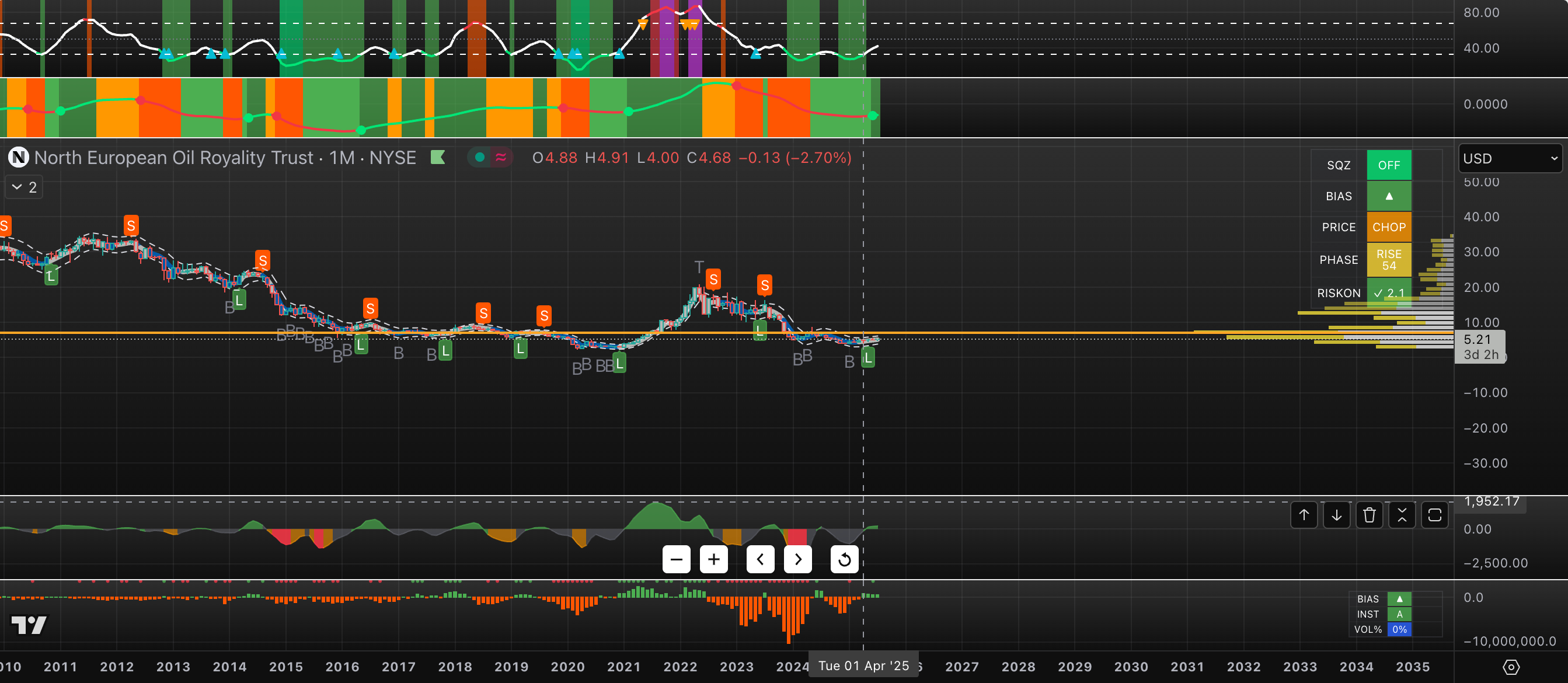
Example: our revcent buy example, NRT an oil and gas pipeline trust - a stock repressed after a decreasign oil and gas prices, under the pressure to reduce inflation.
Leading Indicator Confluence
While the L (Long) signal is our primary trigger, we monitor several leading indicators that often provide early warning of an impending breakout:
Bullish Leading Signals:
Price Pressure turning 🟢 bright green (bullish momentum building)
Volume Pressure showing green accumulation bars (institutional buying)
RVFI generating green signals (positive volume-weighted momentum)
These leading indicators often fire days or even weeks before the L signal, allowing us to prepare and position our watchlist accordingly.
Bearish Leading Signals (for exits/shorts):
T (Top) signals from MXC Duo indicating distribution
Adaptive RSI shifting from red (overbought) to white, signaling momentum loss
Price Pressure transitioning to 🟡 yellow/🟠 orange (weakening momentum)
Volume Pressure shifting to red distribution bars
RVFI showing 🟠 orange/grey zones (institutional selling)
4. Execution Protocol: A Two-Act Play
This playbook is a patient hunt followed by a decisive strike.
ACT I: The Hunt & The Stalk (The Base Phase)
This is where we identify our targets and wait for the perfect moment. The majority of the work is done here, in the quiet before the move.
Signal: This is a two-part signal process.
The Hunt: We use our proprietary market screener to identify a watchlist of assets on high timeframes (2W+) that exhibit:
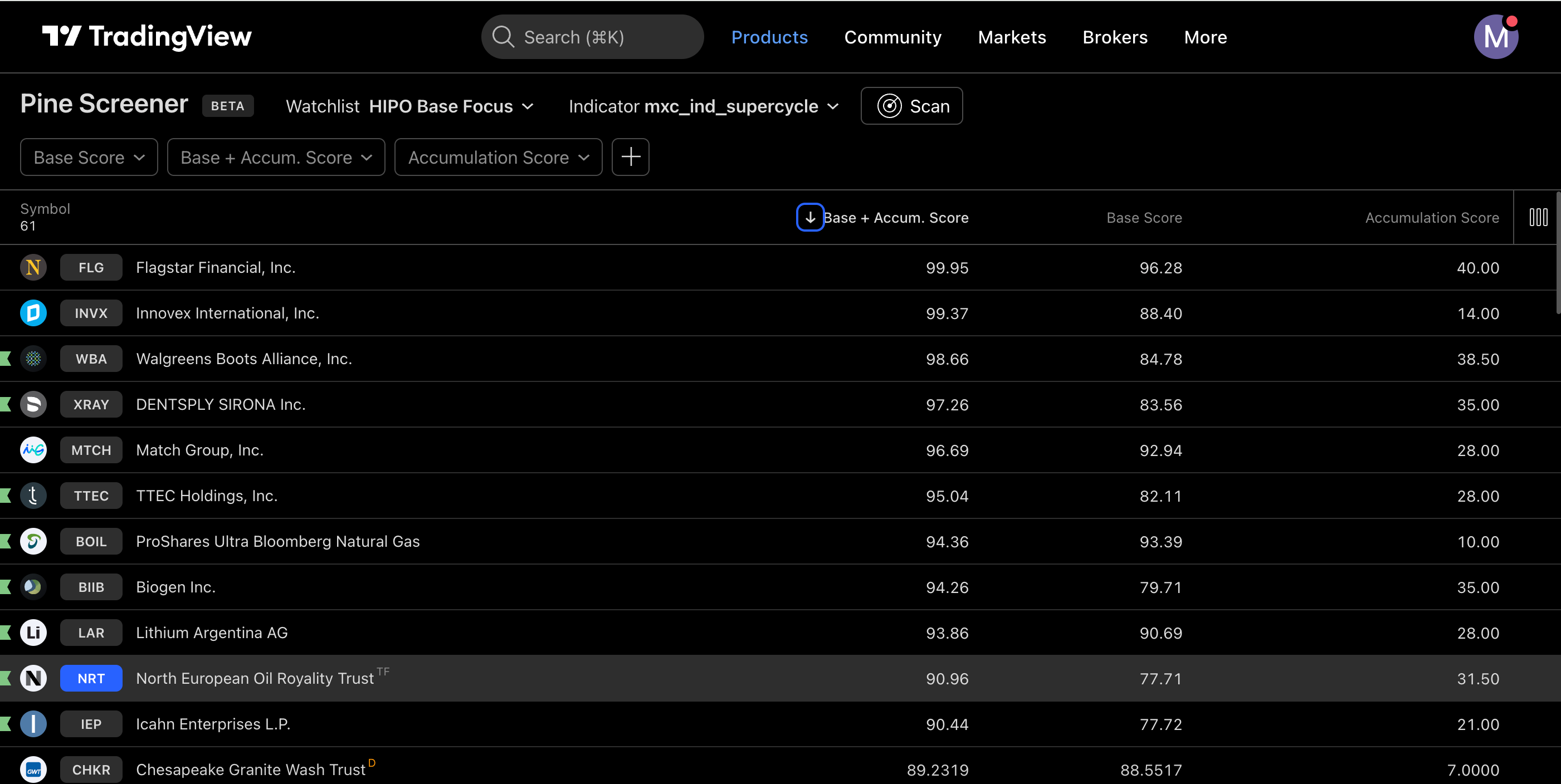
Base Quality Score >70
Accumulation patterns confirmed by multiple indicators
Institutional footprints via Volume Pressure analysis
The Stalk: We monitor this watchlist for:
Leading indicators turning bullish (as described above)
RISKON score climbing above 0.9
Price coiling in the upper portion of the base
Volume contracting to multi-month lows
Execution:
Patience: Do not enter the position yet. The goal is to have the asset on a high-priority watchlist, ready for the catalyst
Advanced (Private Clients): For our private and family office clients, our affiliated fund managers may deploy advanced options strategies to generate income during the basing phase by using put spread options.
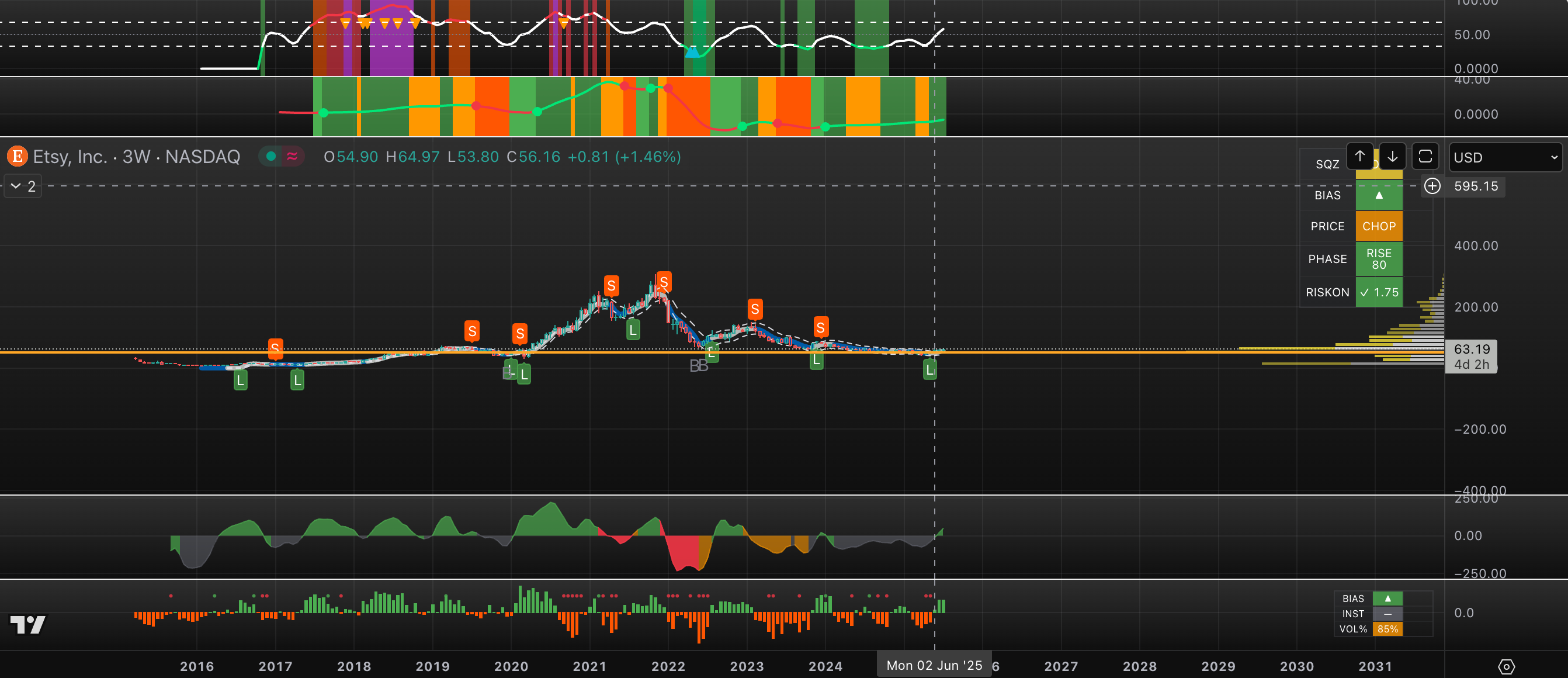
Our process is not theoretical; it is demonstrated in real-time. Consider two recent case studies that highlight our playbook in action: SBSW, a contrarian position in precious metals, and ETSY, a deep value play on the consumer. The charts provide the data-driven signals; our linked research publications unpack the full, second-level thinking and the complete institutional thesis behind each of these high-conviction trades.
SBSW:
The Quiet Roar: Why Smart Money is Stacking Metals (While You're Not Looking)
ETSY:
Etsy: Handcrafted Opportunity?
ACT II: The Breakout & The Ride (The Markup Phase)
This is the ignition event where patience is rewarded with a high-momentum entry.
Signal: The primary entry signal is a high-conviction L (Long) from the MXC Duo Lens Base indicator with:
RISKON score >1.3 (our strong positive threshold)
Leading indicators in alignment (2+ green signals)
Ideally triggered by a fundamental catalyst (earnings, news, sector rotation)
Execution:
Initial Entry: On the confirmed L signal with RISKON >1.3, execute Phase I of our scaling protocol by entering with 40% of your intended position size
Management & Scaling: Execute Phase II and Phase III of the scaling protocol as the position confirms its strength. Hold the full position as long as the indicator remains in a RISE phase
Advanced (Private Clients): For our private and family office clients, our fund managers may utilize proprietary strategies to maximize returns on the initial breakout
Exit Strategy: The Distribution Phase
Primary Exit Signals:
S (Sell) Signal: The primary exit trigger from MXC Duo Lens Base
T (Top) Signal: Early warning of potential distribution
Leading Indicator Divergence: When 2+ leading indicators turn bearish
RISKON Score <0.9: Confidence has deteriorated to neutral/negative
Euphoria Exit: When RISKON exceeds 2.0, consider taking partial profits as markets approach euphoric conditions
Exit Execution:
Long-Only Strategy: Close entire position on S signal
Long/Short Strategy: Flip from long to short position
Trailing Stop Alternative: After +40% gain, implement 10% trailing stop
Profit-Taking Framework (Optional):
At +50% gain: Consider taking 25% off the table
At +100% gain: Consider taking another 25% off
Let remaining 50% run with trailing stop or until S signal
5. Second-Level Thinking: Risk & Context
A Howard Marks Caveat: The primary risk in any breakout strategy is the "false breakout." The entire process of base analysis, institutional tracking, and catalyst confirmation is designed to increase the probability that a breakout is real and sustainable. However, no setup is a certainty. Always position size for the possibility of being wrong.
Risk Considerations:
Stop-Loss Protocol: Our stop-loss for this strategy is set at a generous 20-25% below the initial entry. This is designed to withstand the volatility of a true breakout and retest. By combining this wide stop with our three-phase scaling strategy, the maximum risk on any single position is systematically limited to just 1-3% of the total portfolio.
Patience is Your Primary Edge: The biggest psychological challenge is watching an asset on your list do nothing for weeks or months. Acting too early, before the catalyst and the L signal, is the most common mistake.
Noise Adjustment: Different assets have different volatility profiles. For particularly "noisy" or choppy stocks, you may need to increase the Price Filter and Signal Filter settings in the Duo Base indicator to reduce false signals.
RISKON Threshold Adjustments:
In strong trending markets, you may lower the entry threshold to 1.1
In choppy markets, raise it to 1.5 for additional confirmation
Always respect the >2.0 euphoria warning for profit-taking
Managed Options Strategy: The optional enhancement strategies are exclusively available to our private and family office clients and are executed by our affiliated fund managers. These strategies are designed to generate income during the base phase and amplify returns during breakouts.
6. Implementation Checklist
Before executing this strategy, ensure:
You have access to the MXC indicator suite (Duo Lens Base, Price Pressure, Volume Pressure, RVFI, Adaptive RSI)
You understand the RISKON scoring system and thresholds (0.9, 1.3, 2.0)
You can identify leading indicator confluence patterns
You have the patience to wait for both base completion AND catalyst
You accept the wide stop-loss philosophy and three-phase scaling approach
Your position sizing allows for 6-10 concentrated positions
You have a systematic screening and watchlist management process
7. Final Words
The Investolator strategy represents the synthesis of patient capital accumulation and tactical execution. By combining Ted Warren's base principles, Stan Weinstein's phase analysis, and Capital Cycle theory, we've created a framework that adapts to any asset class while maintaining its core edge.
Remember: The market rewards patience and punishes impatience. Let the institutions do the heavy lifting during accumulation, let the leading indicators guide your preparation, and let the catalyst + L signal with RISKON >1.3 trigger your execution.
The best trades feel like inevitabilities, not gambles. This system is designed to find exactly those opportunities.
8. Appendix: Commodity-Specific Considerations
Commodities require special attention due to their unique characteristics and behavior patterns that differ from equities:
Base Duration Adjustments
Our system automatically detects commodity ETFs and adjusts expectations based on the specific commodity type:
Agricultural Commodities: 3-6 month bases are typical due to faster cycles driven by seasonal factors and harvest patterns
Energy Commodities: 6-12 month bases align with production cycles and capital expenditure timelines
Precious Metals: 12-24 month bases reflect longer accumulation periods and monetary cycle influences
Volatility Adaptations
Commodity markets exhibit higher natural volatility than equities. The MXC Duo Lens Base indicator includes commodity-specific logic that expects approximately 30% wider trading ranges during base formation. This prevents premature signals during normal commodity volatility.
Capital Cycle Alignment
Commodities perfectly exemplify Capital Cycle theory:
Accumulation Phase: Occurs during capital scarcity (mine closures, underinvestment, depleted reserves)
Markup Phase: Triggered by supply/demand imbalance recognition
Distribution Phase: Capital floods in (new mines, increased production capacity)
Markdown Phase: Oversupply leads to price collapse and the cycle repeats
Commodity-Specific Catalysts
Unlike equities where earnings and product launches dominate, commodity catalysts include:
Supply Shocks: Weather events, geopolitical tensions, production disruptions
Demand Surges: Economic recovery, policy changes, technology shifts (e.g., EV adoption for lithium)
Currency Moves: USD weakness typically bullish for commodities
Seasonal Patterns: Particularly relevant for agricultural commodities (planting/harvest cycles)
Special Trading Considerations
When trading commodity ETFs, be aware of:
Contango/Backwardation: Monitor futures curve structure as it impacts ETF performance
Roll Yield: Factor in positive or negative roll yield when using futures-based ETFs
Storage Costs: Particularly impacts precious metals and energy commodities
Weather Patterns: Critical for agricultural positions - monitor long-range forecasts
Geopolitical Risk: Commodities are more sensitive to supply chain disruptions
Commodity Position Management
Given the higher volatility and cyclical nature of commodities:
Consider slightly smaller position sizes (10% vs 12.5% average)
Be prepared for wider intraday swings during accumulation
Monitor correlated commodities for sector-wide moves
Pay special attention to the dollar index as a contra-indicator
Use the full 25% stop-loss given higher volatility
RISKON thresholds remain the same, but expect faster moves between levels
The Investolator framework's emphasis on patient base building and catalyst-driven entries is particularly powerful in commodities, where supply/demand imbalances can create explosive multi-year trends once recognized by the broader market.
Was this helpful?
Still need help? Ask the team