MXC VTM - Volume Timeframe Microstructure
The MXC VTM (Volume Timeframe Microstructure) employs volume microstructure analysis that processes 100% of lower timeframe candles within each higher timeframe bar, revealing hidden institutional patterns through complete data analysis rather than sampling. The core innovation combines volume-weighted pressure calculation (body size × volume), multi-pattern institutional detection (5 distinct fingerprints), and adaptive timeframe selection that automatically optimizes analysis depth. The indicator detects volume/pressure spikes (2x volume + 1.5x pressure), price/volume divergences, hidden accumulation/distribution patterns, and algorithmic trading signatures (>10 small candles with >2% directional bias).
Written By MomentumX Capital
Last updated About 1 year ago
Link to tradingview: mxc_ind_vtm
1. The Premise: Finding the Signal in the Noise
A standard volume bar is a first-level tool that tells a dangerously incomplete story. It shows you how much was traded, but reveals nothing of the battle, the intent, or the conviction within the candle. A big green bar can mask institutional distribution, just as a small red bar can hide massive, quiet accumulation. This is a critical blind spot, and exploiting it is how smart money wins.
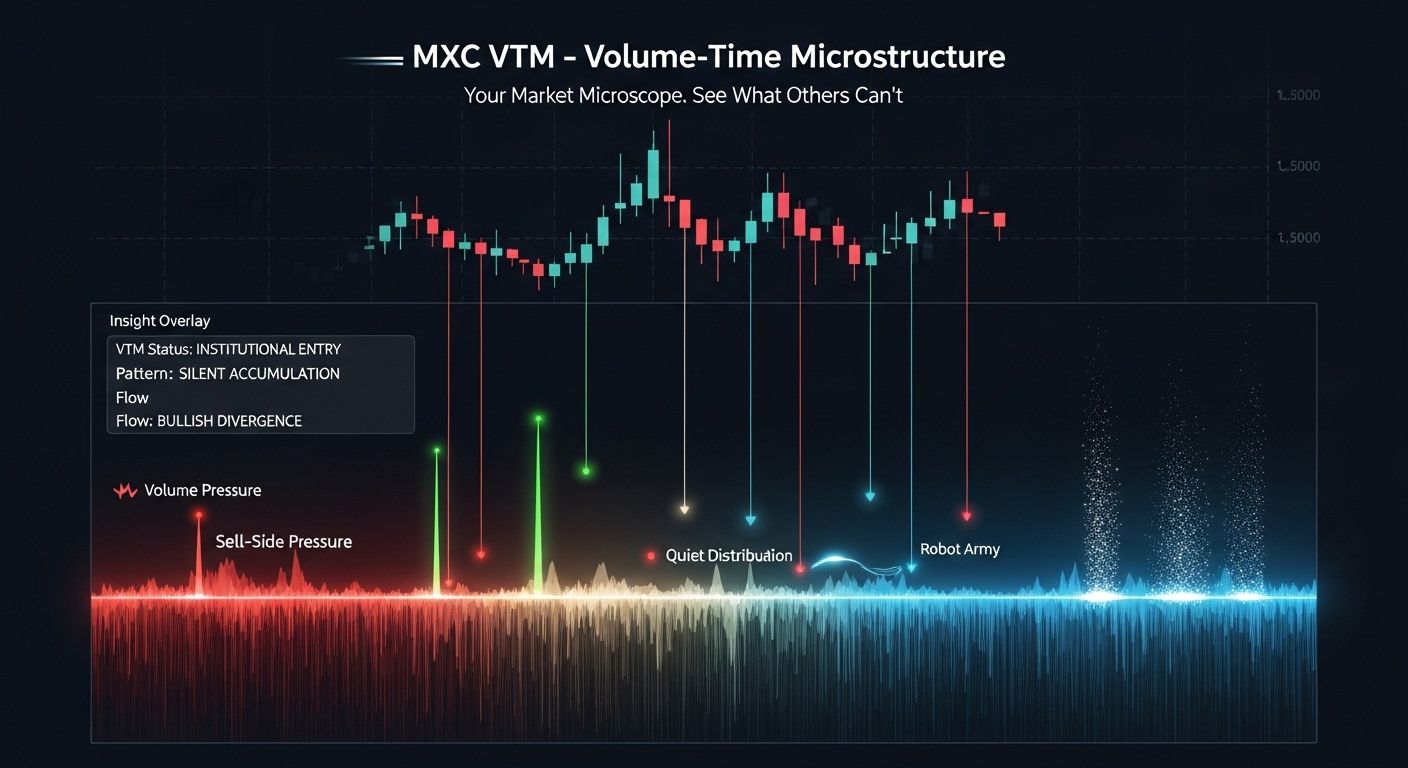
The MXC Volume Timeframe Microstructure (VTM) indicator was engineered to solve this. It is not another volume histogram; it is a microscope for your chart. The VTM goes inside each candle to analyze 100% of the lower-timeframe action, revealing the true order flow and institutional intent that traditional volume bars were designed to hide.
2. The Engine Room: How It Works
To trust the signal, you must understand the engine. The VTM moves beyond sampling to process the complete data set, giving you an uncompromised view of the market's microstructure.
Core Components: The Engineering Behind the Edge
Technical Detail: At its core, VTM processes 100% of lower timeframe candles within each higher timeframe bar using
request.security_lower_tf(). It features Adaptive Timeframe Selection, automatically choosing the optimal analysis depth:
Daily charts → 1-hour candles (24 per day)
4-hour charts → 15-minute candles (16 per bar)
Weekly charts → 4-hour candles (42 per week)
Monthly charts → Daily candles
The system maintains a 7-bar rolling window (auto-adjusted for higher timeframes) and uses 20-bar SMAs as baselines for spike detection. Performance is optimized through cached calculations that update every 5 bars.
The Edge: This is the difference between a blurry satellite photo and high-resolution intelligence. Instead of guessing, you are analyzing the complete, unabridged order flow. The indicator automatically selects the right "magnification level" for your chosen chart.
Key Innovation: Multi-Pattern Institutional Detection
This is the core of our methodology. The VTM's innovation is a two-part system that quantifies intent and then automatically identifies the patterns that matter.
1. Volume-Weighted Pressure Calculation:
For every single lower-timeframe candle, the VTM calculates a pressure score:

This is not just volume; it's volume-weighted intent. It measures the conviction behind the money flow inside each bar, revealing the true winner of the bull/bear fight. The aggregate pressure is normalized to a percentage for easy interpretation.
2. Institutional Fingerprint Recognition:
The system simultaneously tracks five distinct institutional patterns:
Volume/Pressure Spikes: Orders exceeding 2× average volume AND 1.5× average pressure (customizable)
Strong Divergences: When both net volume AND volume-weighted pressure contradict price direction
Hidden Accumulation: Price falling but pressure positive with volume >1.2× average
Hidden Distribution: Price rising but pressure negative with volume >1.2× average
Algorithmic Trading: Detection of >10 small candles with >2% directional bias
The system uses 100-bar percentile rankings to identify extreme readings (top/bottom 10%) and maintains state persistence to prevent whipsaws.
Overview Video
3. The Usage Guide
This isn't just about reading a histogram; it's about interpreting the battle for control of an asset.
Setup & Configuration
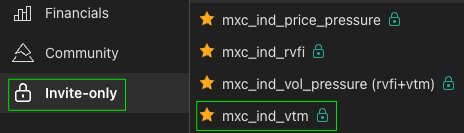
From your TradingView chart, click "Indicators" → “Invite Only” → “mxc_ind_vtm”
Add it to your chart - appears as volume histogram with institutional markers
The default settings are pre-calibrated for strategic positioning
Key Inputs:
Look-Back Period (7): Number of bars for rolling calculations
Volume Spike Multiplier (2.0): Threshold for institutional volume (1.5-3.0 range)
Pressure Spike Multiplier (1.5): Threshold for directional pressure (1.2-2.5 range)
Algorithmic Candle Threshold (10): Minimum candles for algo detection
Algorithmic Bias Threshold (2.0%): Minimum directional bias percentage
Show One Side Only: Option to display absolute values only
Show Info Table: Real-time metrics display (recommended ON)
⚠️ Critical Timeframe Requirements
The VTM is engineered for strategic analysis. Its true power is revealed on higher timeframes where institutional campaigns unfold.
Optimal: Daily and 4-Hour charts
Context: Use Weekly chart to establish long-term institutional bias
Broken: Intraday/sub-1H timeframes capture too much noise
Signal Interpretation Guide 🎯
The Histogram:
🟢 Green Bars: Net bullish pressure - more buying intent than selling
🔴 Red Bars: Net bearish pressure - more selling intent than buying
Bar Size: The magnitude of net pressure
Institutional Activity Dots (The "Delicious" Signals):
🟢 Green Dot: Hidden Accumulation - price falling but institutions aggressively buying
🔴 Red Dot: Hidden Distribution - price rising but institutions using strength to sell
🟡 Yellow Dot: Other institutional activity (spikes, divergences, or algorithmic patterns)
The Info Table:
BIAS: Directional arrow (▲ bullish, ▼ bearish, — neutral)
INST: Specific pattern detected:
HA = Hidden Accumulation
HD = Hidden Distribution
A = Accumulation (non-hidden)
D = Distribution (non-hidden)
ALGO = Algorithmic pattern
DIV = Divergence
VOL%: Current bar's volume percentile rank (0-100%)
Position Sizing by Pattern Conviction
Hidden Accumulation/Distribution: 100% size (highest conviction)
Volume/Pressure Spikes: 75% size (strong confirmation)
Algorithmic Patterns: 50% size (trend-following)
Divergences Only: 25% size (requires price confirmation)
Actionable Playbooks
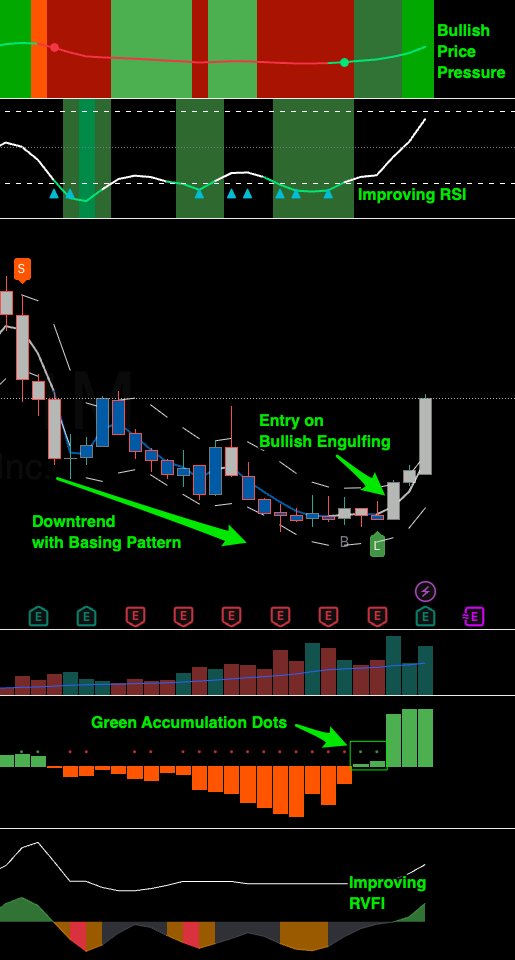
Playbook 1: The Hidden Reversal
Hunt: Wait for established trend. Watch for opposing dots (green in downtrend, red in uptrend)
Confirm: Highest probability when dots appear at key support/resistance with volume >1.2× average
Execute: Enter on first reversal sign (e.g., bullish engulfing after green dot). Stop beyond pattern extreme
Manage: Target significant move back through previous range
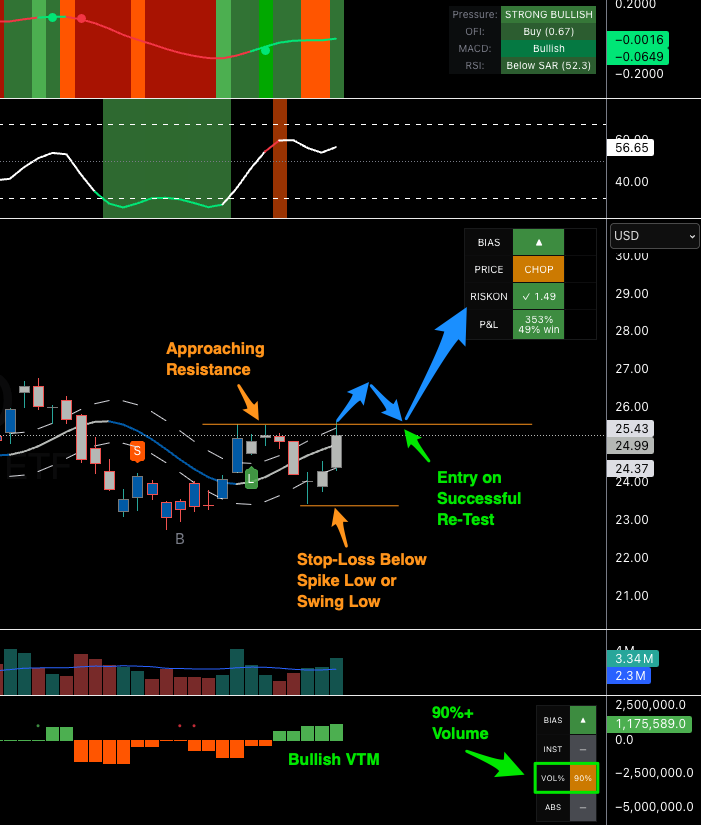
Playbook 2: The Spike Confirmation
Context: Asset approaching breakout level or testing major support
Signal: VOL% >90 as price interacts with level
Entry: On breakout, enter first pullback. On support, enter with tight stop below the candle spike low (conservative), or prior swing low (more room to maneuver).
Exit: Target 2-3× the spike bar's range
4. Second-Level Thinking: Risk & Context
A Howard Marks Caveat: Remember, these are probabilities, not certainties. A green dot is a powerful signal that the odds have shifted in favor of the bulls, but it is not a guarantee. Structure your trades so your winners are multiples of your small, controlled losers.
Multi-Timeframe Confluence
A signal on one timeframe is an observation. A signal confirmed across multiple timeframes is a high-conviction thesis.
The Process:
Use Weekly VTM to identify long-term institutional bias
Use Daily chart to spot high-conviction patterns
Use 4-Hour chart to pinpoint precise entry
All timeframes should show aligned institutional activity
Advanced Features (The Hidden Edge)
Performance Optimization: Cached calculations update every 5 bars to prevent lag
Dynamic Thresholds: User-adjustable multipliers adapt to different market conditions
Percentile Rankings: 100-bar look-back ensures signals remain statistically relevant
State Persistence: Maintains last valid state to prevent choppy whipsaws
Array Validation: Handles missing LTF data gracefully with error checking
Market-Specific Adjustments
For Trending Markets:
Increase look-back to 10-14 bars
Raise thresholds to 2.5×/2.0×
Focus on continuation patterns
For Volatile Crypto:
Keep default settings
Pay extra attention to hidden patterns
Use 4H minimum timeframe
5. The Bottom Line: Your New Edge
Stop guessing what volume means. The VTM provides an unprecedented, microscopic view into order flow, transforming your chart from a simple price graph into a detailed map of institutional intent. By processing 100% of lower timeframe data through sophisticated pattern recognition algorithms, you gain visibility into:
True directional pressure behind each candle
Institutional accumulation and distribution campaigns
Algorithmic execution patterns
Volume/price divergences that precede major moves
It's about moving from reading the chart to reading the tape. It's not about catching every move—it's about catching the moves that matter, backed by the flow of smart money.
The VTM is your institutional-grade microscope, revealing the hidden battles within each candle and giving you the edge to trade alongside the smart money, not against it.
Note: Past performance does not guarantee future results. This tool provides probabilistic insights, not certainties. Always use proper risk management.
Was this helpful?
Still need help? Ask the team