MXC Adaptive RSI
The MXC Adaptive RSI employs a sophisticated multi-stage calculation pipeline that dynamically adjusts RSI length based on market efficiency (0.7x-1.3x multiplier), applies regime-adaptive smoothing through SuperSmoother and triple Gaussian filters, and features asymmetric threshold adjustment using volume impact analysis. The indicator's core innovation lies in its volume-weighted RSI calculation with logarithmic scaling that captures institutional vs retail volume patterns.
Written By MomentumX Capital
Last updated About 1 year ago
Link to tradingview: mxc_ind_adapt_rsi

1. The Premise: Finding the Signal in the Noise
The standard RSI is a relic of a bygone era. It's a rigid, first-level tool that consistently fails in modern markets. It gets stuck "overbought" in a powerful uptrend, whipsawing you out of a winning position, and generates countless false signals in choppy, sideways conditions. Chasing its signals is a frantic game designed for frustration.
The MXC Adaptive RSI was engineered to solve this. This is not another momentum oscillator; it's an institutional-grade momentum engine. It adapts to the market's character in real-time, filters noise through multiple layers of analysis, and incorporates the one thing standard RSI ignores: the footprint of smart money in the volume.
2. The Engine Room: How It Works
To trust the signal, you must understand the engine. The Adaptive RSI is a multi-stage system that replaces static rules with a dynamic, intelligent framework.
Core Components: The Engineering Behind the Edge
The system begins with market regime detection using
mxc.market_trend()to identify trending vs choppy conditions. It then applies regime-adaptive smoothing through a sophisticated cascade: first an Ehlers SuperSmoother with dynamic length (2-10 bars based on choppiness), followed by a triple Gaussian filter sequence called 3 times) for progressive noise reduction.
mxc.gma_fb()The RSI calculation itself uses
mxc.drsi()with a dynamic length that scales from 0.7x to 1.3x the base setting based on price efficiency metrics.
The Edge: The indicator automatically "changes gears" for different road conditions. It shortens its look-back in fast-moving trends (high price efficiency) to keep you responsive, and lengthens it in consolidations (low price efficiency) to keep you from getting shaken out by noise.
Key Innovation: A Multi-Layered Intelligence System
This is where the Adaptive RSI creates its definitive edge. It goes beyond simple momentum by integrating three layers of advanced analysis:
Volume-Weighted Calculation: We incorporate a sophisticated volume-weighted RSI using logarithmic scaling, capped at 2x to prevent outliers:
log_volume_factor = log(1 + relative_volume) / log(2)The final RSI is a dynamic blend:
emaRSI * (1 - adjusted_vw_weight) + smooth_vw_rsi * adjusted_vw_weightThis captures the nuanced difference between high-volume institutional moves and low-volume retail noise.
Adaptive Threshold Technology: Static 70/30 levels are replaced with dynamic thresholds that incorporate:
Asymmetric volume impact adjustment (stronger for spikes, weaker for drops)
ATR-based volatility bands (±25% maximum adjustment with 2% hysteresis protection)
Market regime factors from trend strength and choppiness metrics
RSI velocity filtering that applies 5% reduction when momentum opposes position
Overview Video
3. The Usage Guide
This isn't just about reading a line; it's about executing a repeatable, disciplined process.
Setup & Configuration
From your TradingView chart, click "Indicators" and search for "MomentumX Adaptive RSI"
Add it to your chart. The default settings are pre-calibrated for strategic positioning.

Key Inputs:
RSI Length (7): Base calculation period that the system dynamically adjusts. Lower values are more responsive, while higher values place more significance on signal quality.
EMA of RSI Length (5): Final smoothing for signal stability. Higher values smooth more noise.
Look-Back Length (5): Historical reference for adaptive calculations.
Base Overbought (67.5) / Oversold (33.5): Starting points for dynamic thresholds. For more ‘strict’ thresholds and to highlight more “extremes”, move closer to 80/20. For ‘less strict’ thresholds, move both closer to 50.
Enable Volume-Weighted RSI: Toggles institutional volume analysis (Recommended: ON)
Volume Weight Factor (0.7): Blends the ratio between standard and volume-weighted RSI (0.1-1.0). Higher values mean greater volume impact on Adaptive RSI.
⚠️ Critical Timeframe Requirements
The Adaptive RSI is engineered for strategic analysis, not day-trading. Using it on improper timeframes will degrade or break the signal.
Crypto: Use 4H as your base chart.
Stocks/TradFi: Use Daily chart as your base.
Forex: Use 4H as your base, similar to crypto markets.
Signal Interpretation Guide
Line Color & Background Gradients:
🔴 Fuchsia (≥82): Extreme overbought - highest reversal probability
🔴 Red (≥75.5): Strong overbought - monitor for weakness
🟠 Orange (≥67.5): Standard overbought - early warning zone
🟢 Lime (≤25): Extreme oversold - highest bounce probability
🟢 Green (≤30): Strong oversold - monitor for strength
🟢 Light Green (≤33.5): Standard oversold - early warning zone
⚪ White Line: RSI turns white at extremes for immediate attention
Smart Money Markers:
💧 Aqua Triangle (Bottom): Hidden accumulation - appears when RSI ≤38.5, volume >1.5x 20-period average, and price declining
🔻 Orange Triangle (Top): Hidden distribution - appears when RSI ≥62.5, volume >1.5x average, and price rising
Position Sizing by RSI Level
Extreme Oversold (≤25): 100% position size
Standard Oversold (25-33.5): 75% position size
Neutral (33.5-67.5): 50% position size
Standard Overbought (67.5-75.5): 25% position size
Extreme Overbought (≥75.5): No new long positions
Actionable Playbooks
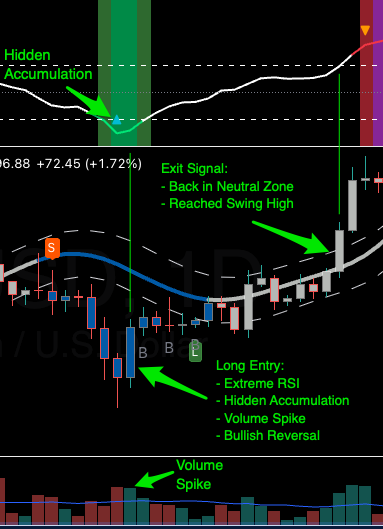
Playbook 1: The Extreme Reversal
Hunt: Wait for RSI to reach extreme zone with fuchsia (≥82) or lime (≤25) background
Confirm: Look for volume spike (>1.2x 20-period average) and/or hidden accumulation/distribution marker
Execute: Enter on first reversal after extreme reading, stop beyond recent swing
Manage: Target return to neutral zone (~50) for initial profits
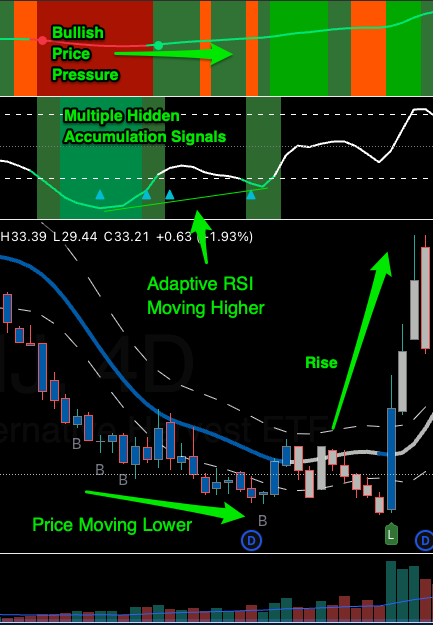
Playbook 2: Volume-Divergence Institutional
Setup: Monitor for divergence between price and volume-weighted RSI
Bullish: Lower price lows with higher RSI lows + volume momentum positive
Bearish: Higher price highs with lower RSI highs + volume momentum negative
Confluence: The signal becomes stronger when multiple indicators support the divergence in Adaptive RSI. For example, a bullish divergence in Adaptive RSI, combined with another bullish signal (Price Pressure, RVFI, VTM).
Execute: Enter after 2-3 bars of divergence confirmation with volume >1.2x average
Manage: Exit on return to Neutral or opposing extreme zone.
4. Second-Level Thinking: Risk & Context
A Howard Marks Caveat: Remember, these are probabilities, not certainties. An extreme reading doesn't guarantee a reversal; it simply means the odds have shifted dramatically in your favor. The goal is not to be right 100% of the time, but to structure your trades so that your winners are multiples of your small, controlled losers.
Advanced Features (The Hidden Edge)
The indicator's engine includes additional layers of protection and accuracy:
Directional Weighting: Applies up to ±60% signal boost based on trend strength
Velocity Filtering: 5% signal reduction when RSI momentum opposes position at extremes
Volume Momentum Analysis: Tracks 3-period volume rate of change and acceleration
Market Metrics Integration: Uses volume quality, price efficiency, and choppiness index
Hysteresis Protection: 2% threshold bands prevent signal whipsawing
Final Smoothing Cascade: EMA smoothing after all calculations for stable signals
5. The Bottom Line: Your New Edge
Stop relying on a broken tool. The standard RSI is obsolete. The MXC Adaptive RSI Pro is the professional-grade engine for modern markets. By integrating volume through logarithmic scaling, adapting to market regimes via efficiency metrics, it provides what every investor seeks: momentum with context and conviction.
The indicator's sophisticated calculation pipeline - from dynamic RSI length through triple Gaussian smoothing to volume-weighted blending - delivers institutional-grade analysis in an intuitive interface. This is momentum analysis evolved.
Note: Past performance does not guarantee future results. This is a tool for strategic positioning, not a crystal ball. Always use proper risk management.
Was this helpful?
Still need help? Ask the team