Index: Leveraged Accumulation
This is our definitive playbook for compounding generational wealth. It's engineered to systematically identify moments of maximum pessimism in major US indices using our MXC Duo Index on high timeframes. We then use a core tool of sophisticated capital—leveraged ETFs like TQQQ and SPXL—to amplify the subsequent multi-year bull cycle. The protocol is mechanical: accumulate on a confirmed 'Long' signal, ride the primary trend, and preserve capital on the 'Sell' signal. This is a disciplined framework for letting the market's most powerful waves do the heavy lifting.
Written By MomentumX Capital
Last updated About 1 year ago

1. The Premise: Leveraged Index Accumulation
First-level thinking either tries to day-trade market bottoms or is too paralyzed by fear to act at all. Both are recipes for failure. We play a different game. This playbook is our definitive, long-term wealth compounding strategy, designed to systematically exploit the market's major cycles with institutional precision.
The goal is not to chase daily moves. The goal is to identify major market bottoms (accumulation zones) on high timeframes (multi-week to monthly charts) and use a core tool of sophisticated capital—leveraged ETFs—to maximize appreciation during the subsequent multi-month or multi-year bull cycles. We are not shorting or timing the top; we are systematically buying deep value in the world's most important indices and patiently riding the primary trend. This is a playbook about conviction, compounding, and letting the market's biggest waves do the heavy lifting.
2. Operating Parameters
Asset Class: Major US Indices, executed via Leveraged ETFs (e.g., TQQQ for NASDAQ 100, SPXL for S&P 500).
Timeframe: High Timeframe (HTF) Strategic Positioning (2-Week, 3-Week, and Monthly charts).
Style: Long-Only, Accumulation & Compounding.
Primary Indicators: MXC Duo Index
Supporting Indicators: MXC Adaptive RSI, MXC Price Pressure, MXC Volume Pressure
Position Sizing: Maximum 30% of portfolio in leveraged ETFs. Start with 15-20% initial position, scale to 30% only after confirmed RISE phase. Never go all-in on leveraged products.
Allocation: User-defined based on index preference (e.g., 100% TQQQ or a 50/50 split of TQQQ/SPXL) - note that each index might have a signal at a different time.
3. Execution Protocol: The Compounding Cycle
This playbook operates as a simple, powerful cycle of accumulation during strength and capital preservation during weakness. It is intentionally designed to be low-touch and mechanical.
Sample - 2W chart for TQQQ:
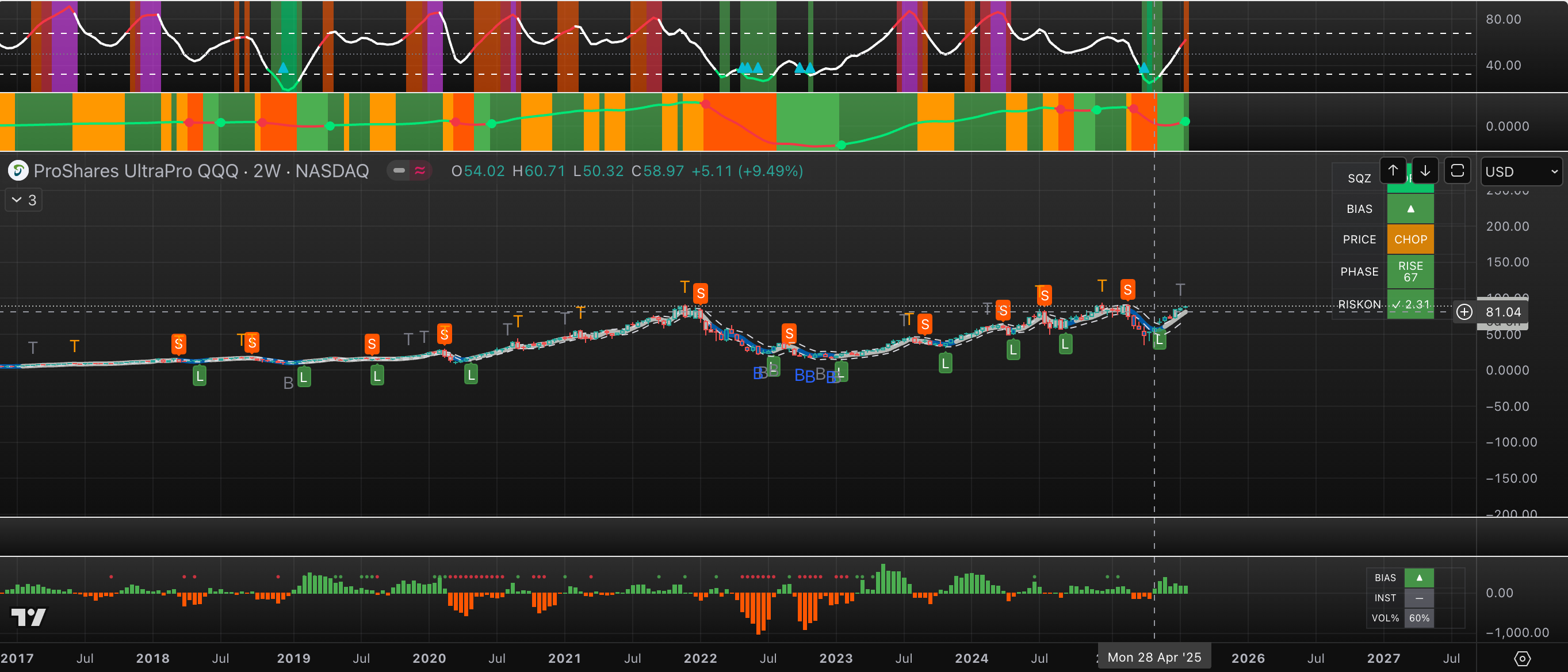
On this 2W TQQQ chart, the L (Long) and S (Sell) signals from our Duo Index are the final, decisive confirmations. However, the early warning—the institutional footprints—appears first in our supporting indicators. A potential top often begins with a shift in Price Pressure from bullish green to weakening yellow/orange. We then cross-reference this with our VTM to confirm net negative volume pressure, indicating that smart money is distributing into strength. The subsequent 'S' signal is not a guess; it's the market's official acknowledgment of the underlying weakness we were already tracking.
This exact process is unfolding now. The latest 'L' signal fired on April 28th, 2025, confirming a new markup phase built upon a base of strong accumulation volume. While minor pullbacks are expected noise, the primary trend is firmly up. The playbook is simple: hold the core position and systematically add capital on a weekly or monthly basis. This is how you compound wealth—by patiently riding a confirmed institutional trend, not by reacting to daily volatility.
Sample - 1M chart for SPXL:
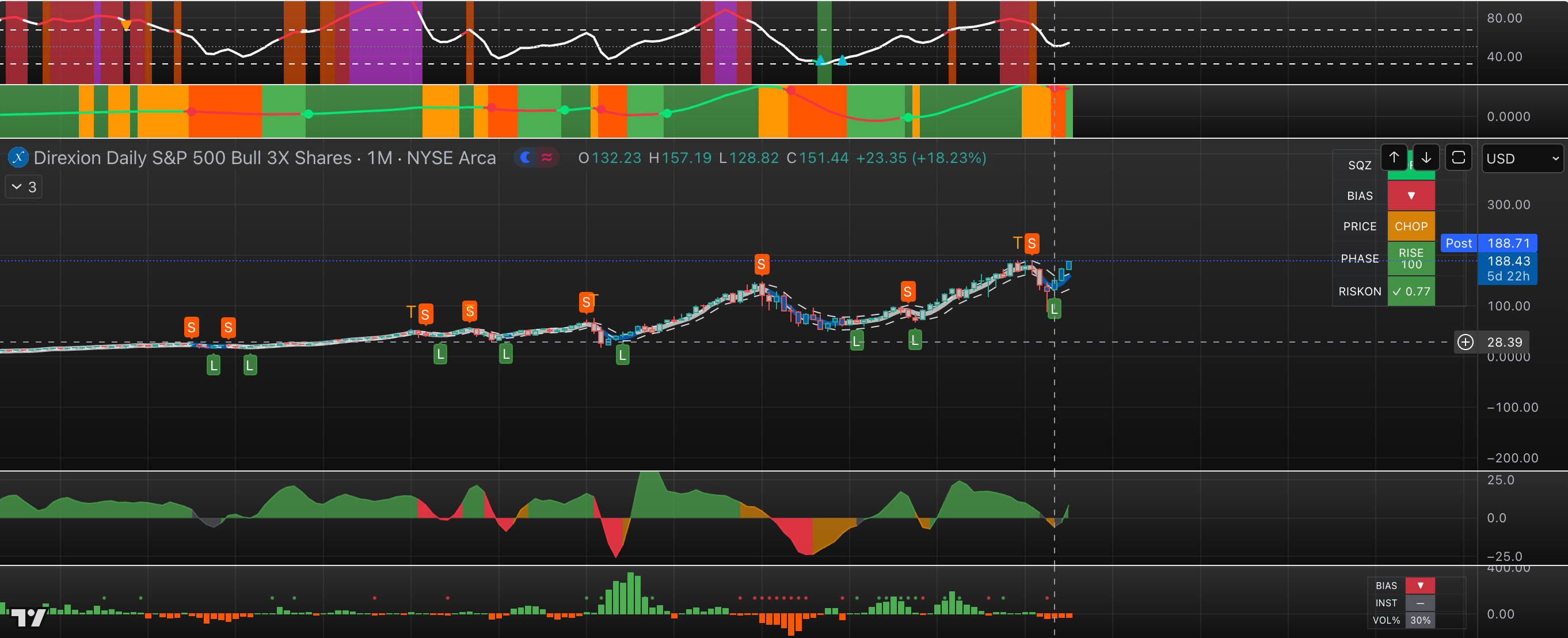
The same logic applied on this SPXL 1M chart.
ACT I: The Accumulation & Ride (The Long Game)
This phase is about establishing a core position at a high-probability market bottom and patiently adding to it as the new bull market finds its footing.
Signal: The hunt begins when the MXC Duo Index prints a high-conviction L (Long) signal on your chosen high timeframe (e.g., 3-Week). The signal is most powerful when it appears after a B (Bottom) signal has been printed, confirming the start of a new major cycle.
Execution:
Initial Entry: Upon the close of the first confirmed L (Long) signal candle, enter your initial position (15-20% of portfolio). The entry does not need to be perfect; we are positioning for a multi-year trend.
Activate DCA: Establish an automated weekly or monthly investment plan to systematically add to your position. This allows you to continue accumulating capital while the primary trend is in your favor.
Scale to Full Position: Once the MXC Duo Index confirms a RISE phase, scale your position up to the maximum 30% allocation.
Hold: Your job is to hold this position and continue your automated additions. Do not be shaken out by normal pullbacks. The system is designed to ride the primary trend, which can last for many months or even years.
Quarterly Rebalancing: If TQQQ/SPXL allocation drifts >10% from target, rebalance back to original weights. This prevents overconcentration in the outperforming index.
ACT II: The Distribution (The Harvest)
All bull markets end. The purpose of this phase is not to perfectly time the top, but to systematically exit the position when the data shows the primary trend has broken, thereby preserving capital.
Signal: The exit signal is a confirmed S (Sell) signal on the MXC Duo Index on the same high timeframe you used for entry.
Execution:
Cease DCA: Immediately stop all automated buys.
Sell Down: Upon the close of the S (Sell) signal candle, close your position. You have two pre-determined options based on your risk tolerance:
Standard Protocol (Recommended): Sell 100% of your position. Move fully to cash to protect capital and wait for the next cycle.
Aggressive Protocol: Sell 50% of your position, holding the rest as a core long-term holding.
Wait: Patiently hold your capital in cash. Do not be tempted to short. Wait for the next high-conviction L (Long) signal to re-enter and begin the accumulation cycle anew.
4. Options Enhancement Strategy (Coming Soon)
We are developing a complementary options strategy that will enhance returns during two critical phases:
Phase 1: Initial Breakout Capture
Use call options to gain leveraged exposure during the initial L signal confirmation
Benefit from explosive moves off major bottoms with limited capital at risk
Phase 2: Trend Riding Enhancement
Transition from options to leveraged ETFs once trend is established
Use covered calls during extended RISE phases for additional income
This hybrid approach will allow for maximum capital efficiency: options for the high-volatility breakout phase, then leveraged ETFs for the steady trend phase. Full details and execution protocols coming in the next playbook update.
5. Second-Level Thinking: Risk & Context
A Howard Marks Caveat: This playbook's "low-risk" nature refers to the timing of the entry—buying at major market bottoms when probabilities are heavily in your favor. It does not refer to the instruments themselves. Leveraged ETFs are sharp, sophisticated tools. When used correctly within this framework, they accelerate wealth. When used improperly, they can cause rapid and significant losses.
Risk Considerations:
Volatility Decay is Real: Leveraged ETFs are not buy-and-hold-forever instruments. They are designed to be held during clear, confirmed uptrends, which this playbook identifies. Holding them during extended sideways or choppy (CHOP) markets will lead to value erosion due to their daily rebalancing mechanism.
Discipline Over Greed: This strategy intentionally avoids shorting to reduce complexity and risk. Do not be tempted to short the S signal. Its sole purpose is to signal an exit from your long position to preserve capital.
The Psychology of the Bottom: The greatest challenge of this strategy is having the conviction to execute a large buy when the market sentiment is at its absolute worst. Trust the data, not the headlines.
The Simplicity is the Strategy: The power of this playbook lies in its simplicity and mechanical nature. Avoid the temptation to over-trade or outsmart the signals. The goal is to capture the big, obvious trends, not every minor wiggle.
Note: Past performance does not guarantee future results. This tool provides probabilistic insights, not certainties. Always use proper risk management.
Was this helpful?
Still need help? Ask the team