MXC RVFI - Relative Volume Force Index
The MXC RVFI is an adaptive volume-momentum oscillator featuring self-optimizing parameters, dynamic lookback periods, and percentile-based statistical coloring. It excels at detecting early bullish reversals when approaching at high momentum from oversold conditions, with visual alerts through intelligent color coding that adapts to each asset's unique volatility profile.
Written By MomentumX Capital
Last updated About 1 year ago
TradingView Name: mxc_ind_rvfi
1. The Premise: Finding the Signal in the Noise
Market noise high? Good. Let's find the signal.
Most investors fly blind when it comes to volume. They chase green bars and panic at red ones. This is first-level thinking—a frantic, high-stress game of reacting to noise, and it's the fastest way to provide exit liquidity for the smart money.
The MXC Relative Volume Force Index (RVFI) was engineered to solve this. It is not another volume oscillator; it is our institutional footprint detector. Its sole purpose is to filter the market's noise and reveal the one thing that truly matters: the quiet, methodical force of institutional capital.
2. The Engine Room: How It Works
To trust the signal, you must understand the engine. The RVFI is a multi-stage system that combines advanced filtering with a robust statistical framework to produce a clear, quantifiable edge.
Core Components: The Engineering Behind the Edge
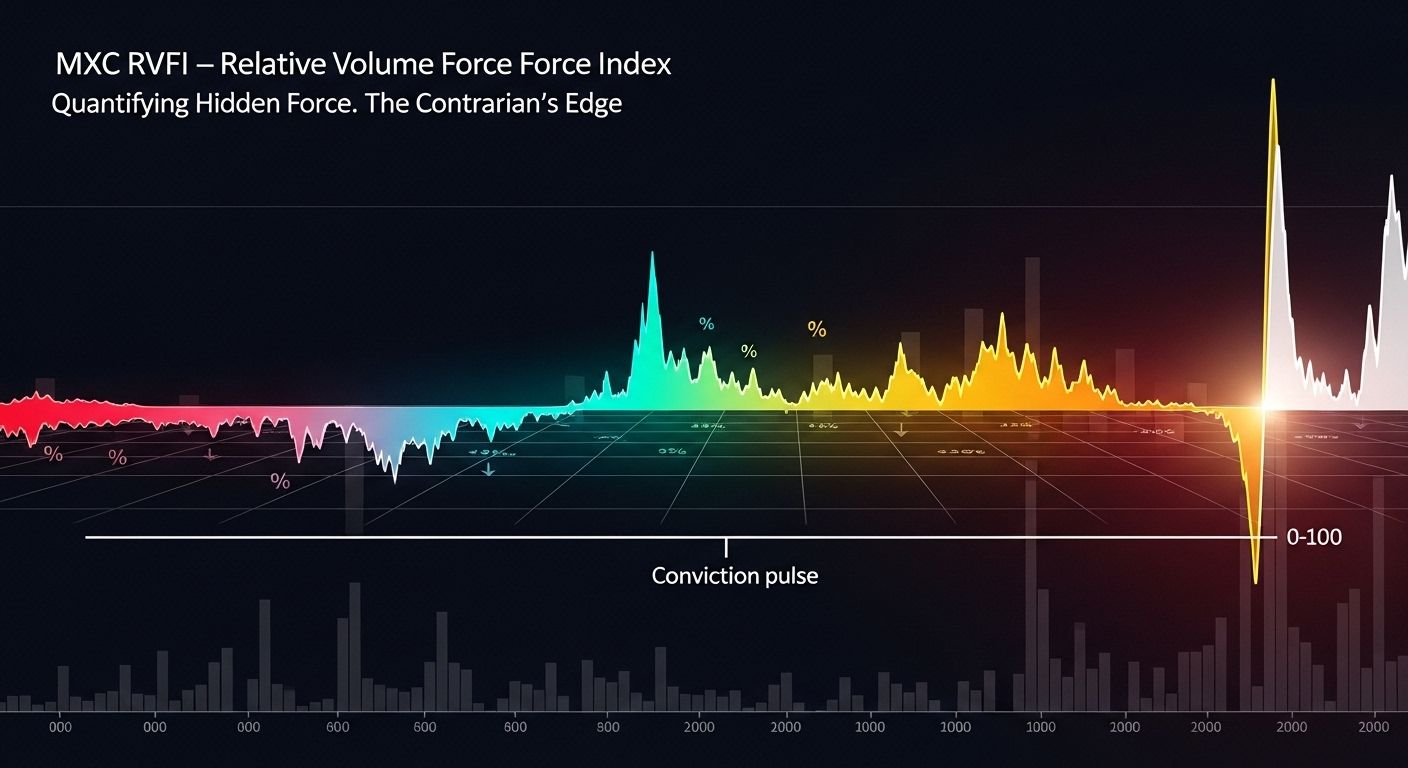
The system begins with an advanced smoothing pipeline, processing raw data through an Ehlers SuperSmoother and adaptive Kalman filters. This aggressively strips out market static, ensuring we analyze the true signal. We then apply a statistical reality check: a rolling Z-Score is calculated to measure the deviation of volume force from its recent mean, which is then converted into a simple 0-100 Percentile Rank. This tells you instantly if market activity is a statistically significant event or just random market chatter.
Key Innovation: The Hybrid Scoring System
This is the core of our methodology. The RVFI's innovation is a three-part system that creates a single, unambiguous signal of institutional intent:
Force Vector Calculation: We measure price change weighted by volume^1.2, giving enhanced sensitivity to significant, institution-led volume events. This is how we see the footprints.
Dual-Scoring Mechanism: This vector is processed by two simultaneous engines: a tanh-based position score that smoothly maps conviction on a 0-1 scale, and a TSI momentum score that captures directional strength.
Adaptive Alignment: The final score rewards agreement between momentum and position, creating a highly reliable signal. The system automatically adapts its parameters (e.g., K=1/D=11 for crypto, K=3/D=7 for TradFi) for optimal relevance.
Overview Video:
3. The Usage Guide
This isn't just about spotting colors; it's about building a repeatable, disciplined process.
Setup & Configuration
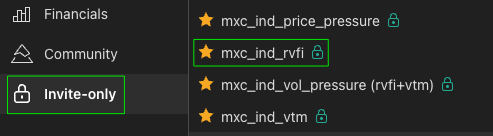
From your TradingView chart, click "Indicators" → “Invite-only” → “mxc_ind_rvfi”
Add it to your chart. The default settings are pre-calibrated for strategic positioning on higher timeframes. For 95% of users, these settings are optimal.
Key Input: The only parameter to consider is Show RVFI Score. Toggling this on displays a 0-100 score representing volume conviction. A breakout on a score > 70 is a high-conviction signal.
⚠️ Critical Timeframe Requirements
The RVFI is engineered for strategic positioning only:
Optimal: 2-4 day charts (crypto), 2+ week charts (traditional markets)
Degraded: Daily charts show more noise
Broken: Intraday/sub-daily - DO NOT USE
Signal Interpretation Guide
🔴 Red (Extreme Oversold: ≤5th Percentile): The point of maximum pessimism. Statistically rare selling pressure signals a high probability of a reversal. Action: Cease selling/shorting. Hunt for a reversal setup and wait for momentum to confirm a bottom.
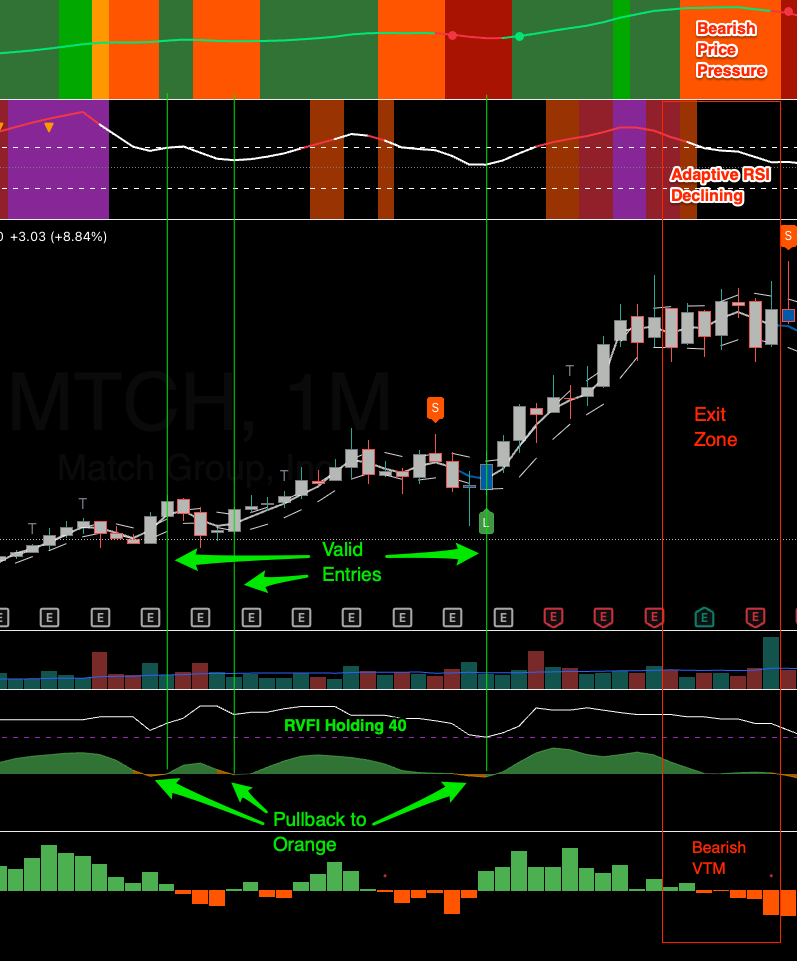
🟠 Orange (Standard Oversold: ≤20th Percentile): A common pullback zone. In a confirmed uptrend, this is a prime area to add to a position. Action: In uptrends, look to scale in. In downtrends, await further confirmation.
🟡 Yellow (Momentum Confirmation): The ignition signal. Strong momentum improvement with volume confirmation (RVFI score ≥ 0.45), typically emerging from oversold (z-score improving) or early bullish territory (RVFI ≥ -20 with stable strength). Action: This is your primary entry signal for a new long position. Place initial stop below the recent low.
🟢 Green (Risk-On): A healthy, confirmed uptrend supported by institutional flow (RVFI ≥ 0.5). Action: Maintain your long bias. Add on pullbacks to orange. Trail stops aggressively.
⚫️ Dark Gray (Neutral): The market is taking a breath; a state of indecision. Action: Often, the most profitable move is to do nothing. Patience is a position.
📊 Position Sizing by RVFI Score
Score 70-100: Full position (high conviction)
Score 50-70: 75% position (standard conviction)
Score 30-50: 50% position (exploratory)
Score <30: No new positions
Actionable Playbooks
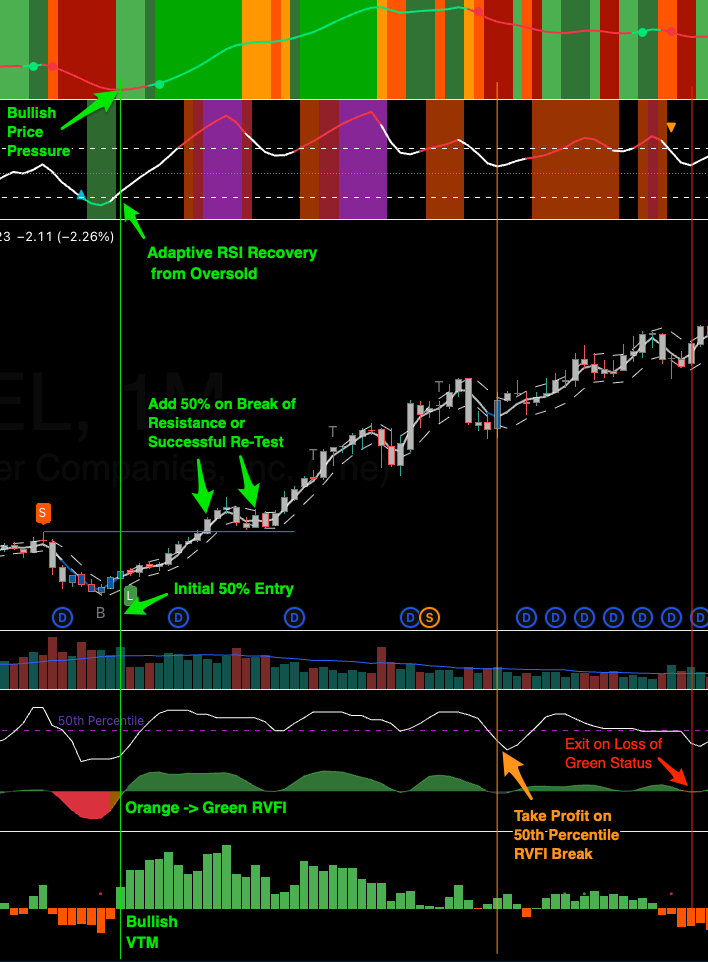
Playbook 1: The Contrarian Reversal
Hunt: Wait for a red extreme signal.
Confirm: Do not act on red alone. Combine with supporting confluence from either Price Pressure, Adaptive RSI, VTM, etc.
Execute: Enter 50% of your position if 2+ indicators align; add 50% on a break of near-term price resistance and/or successful re-test.
Manage: Take partial profits when RVFI breaks below the 50th percentile. Trail the remainder, exiting on a loss of green status.
Playbook 2: The Trend Rider
Context: Identify an established uptrend with the RVFI in a Green state.
The Dip: Wait for a healthy pullback into the orange zone. Ensure the RVFI score remains healthy (> 40).
The Entry: Execute your buy when the color flips from orange back to gray or blue-green.
The Exit: Exit on a shift from Green to Red, or if at least 2+ indicators show bearish confluence.
4. Second-Level Thinking: Risk & Context
A Howard Marks Caveat: Remember, these are probabilities, not certainties. The goal is not to be right 100% of the time, but to structure your trades so that your winners are multiples of your small, controlled losers. Risk management is the whole ballgame.
Multi-Timeframe Confluence
A signal on one timeframe is an observation. A signal confirmed across multiple timeframes is a high-conviction thesis.
The Process: Always start with the higher timeframe (e.g., weekly, monthly) to establish the primary trend. Then, use the daily chart to time entries that align with that larger trend.
Advanced Features
Adaptive Look-Back: The indicator automatically adjusts its analysis window based on market conditions
Hysteresis Protection: Built-in 2% threshold bands prevent signal whipsawing
Volume-Adaptive Response: Reduces smoothing during high-volume events for faster institutional flow detection
5. The Bottom Line: Your New Edge
Stop reacting to price. Start reading the force behind it. The RVFI is a professional-grade tool designed to see the institutional footprints so you can position yourself with the current of the market, not against it. It's not about catching every move—it's about catching the moves that matter with institutional-grade conviction.
Remember: The RVFI excels at identifying "smart money" accumulation phases before major moves. Use it as your primary volume analysis tool, but always confirm with price structure and broader market context.
Note: Past performance does not guarantee future results. Always use proper risk management. The RVFI is a tool for strategic positioning, not a crystal ball.
Was this helpful?
Still need help? Ask the team