A Practical Guide to Our Position Sizing & Execution Protocol
Written By MomentumX Capital
Last updated About 1 year ago
This guide outlines the disciplined, risk-managed process we use for capital deployment. A signal is only the starting point; a systematic execution plan is what generates consistent returns.
A Note on Strategy Application
The 40-40-20 Protocol detailed below is our primary method for scaling into new positions, particularly for our core "Base & Catalyst" strategy. However, investing is dynamic. We may make exceptions and adjust this protocol based on the unique risk profile and potential of a specific opportunity. Any deviations will be clearly noted in the Status / Action column of the positions table.
The 40-40-20 Scale-In Method
Our entry protocol is structured in three tranches to manage risk while capitalizing on confirmed strength.
Phase 1: Initial Entry (40% of Position Size)
Action: Deploy the first 40% of your planned capital upon receiving a valid buy signal.
Rationale: This initial tranche establishes a position while keeping risk minimal as the thesis develops. A stop-loss is set immediately based on the chart's technical structure.
Phase 2: Confirmation Entry (40% of Position Size)
Action: Deploy the next 40% after the market confirms the move (e.g., a successful retest of a breakout level).
Rationale: We add capital only after receiving evidence that our initial thesis is correct. The stop-loss is then adjusted (often to breakeven) to manage risk on the larger position.
Phase 3: Trend Entry (20% of Position Size)
Action: Deploy the final 20% once a clear, established uptrend is in motion.
Rationale: This final tranche is deployed into proven strength, allowing us to maximize our exposure to the most profitable part of a trend.
Portfolio Construction: A Practical Example
We recommend a focused portfolio of 6-10 high-conviction positions.
Scenario: A $25,000 portfolio targeting 10 positions.
Define Full Position Size: Each position will have a maximum allocation of 10%.
Full Position Size = $25,000 x 10% = $2,500
Calculate Initial Deployment (Tranche 1): The first entry is 40% of the full position size.
Initial Deployment = $2,500 x 40% = $1,000
This initial trade risks only 4% of the total portfolio (
$1,000 / $25,000), demonstrating how the protocol controls risk from the very first step.
How to Read the Positions Table - The Flight Deck
The positions table is your actionable flight plan. It is the practical application of our strategy, designed to be read and acted upon with clarity.
Entry,Stop SL,Exit Target: These define the parameters for each trade. TheEntryis the initiation price, theStop SLis our pre-defined risk limit, and theExit Targetis our objective.Pos Size %: The total intended allocation for a position once all three tranches are deployed.% Cap(Capital at Risk): The single most important risk metric. This shows the actual percentage of your total portfolio you stand to lose if a trade hits its stop-loss.R:R(Risk:Reward Ratio): Quantifies the asymmetry of the trade, showing the potential reward for every dollar of risk taken.Status / Action: Your direct instruction. This column tells you precisely what to do: initiate a new buy, scale an existing position, adjust a stop-loss, or hold.Scaling in Plan (40% | 40% | 20%): A visual tracker of our protocol. A green block indicates a tranche is active; a grey block indicates capital is awaiting a confirmation signal.
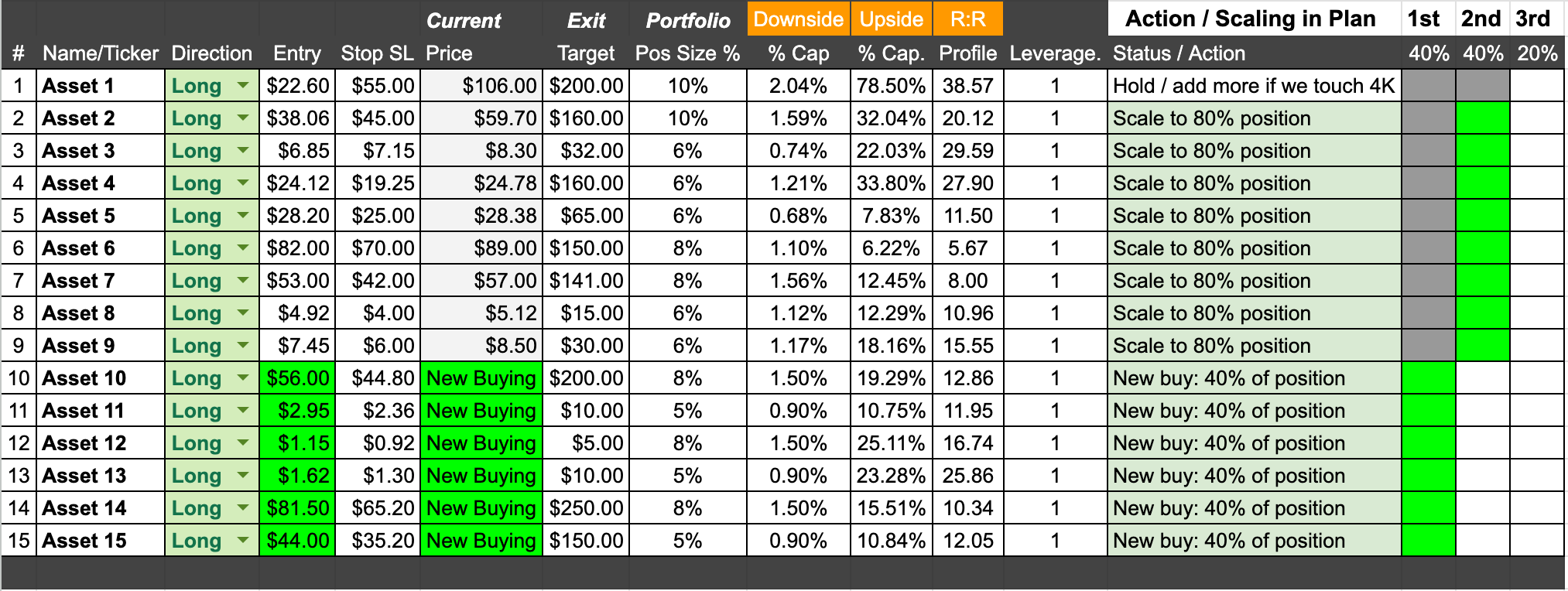
Note: This protocol is primarily applied to the Base & Catalyst strategy, we can make exceptions depending of the level of risk and potential of a given position.
Was this helpful?
Still need help? Ask the team